
Agentic Workflows, Business Economics, and What’s Really Changing in SEO
Welcome back! It’s been a busy period — there have been several speaking gigs on the go, with another one coming up next week on the topic of agentic workflows. If you’re interested in getting started with agentic workflows, there’s a link in the description — just reach out and I’ll send through the materials that have been shared with those audiences.
Mind Blown — Again
Every week there’s something new to wrap your head around, and this week is no different. Rather than rehashing all the Google changes from last week, it’s worth pointing out that those changes have been predicted for the last three years. Right now there’s a lot of noise about needing to “replace yourself with AI,” but if you go back and watch videos from three years ago, that’s exactly what was being said then. The message has always been to focus on building a stronger brand — and there’s more coming in that area soon.
But what’s truly been mind-blowing lately is the power of agentic workflows and what they mean for business economics.
The Hermes Agent: A Business Game Changer
Several different agents have been set up for different business functions. The one at the centre of it all is the Hermes agent — an agentic harness that gets smarter every single day. Its memory improves continuously, building deeper knowledge of the business, workflows, client context, client goals, and more. Think of it as the best personal assistant you could ever have, but it goes well beyond that.
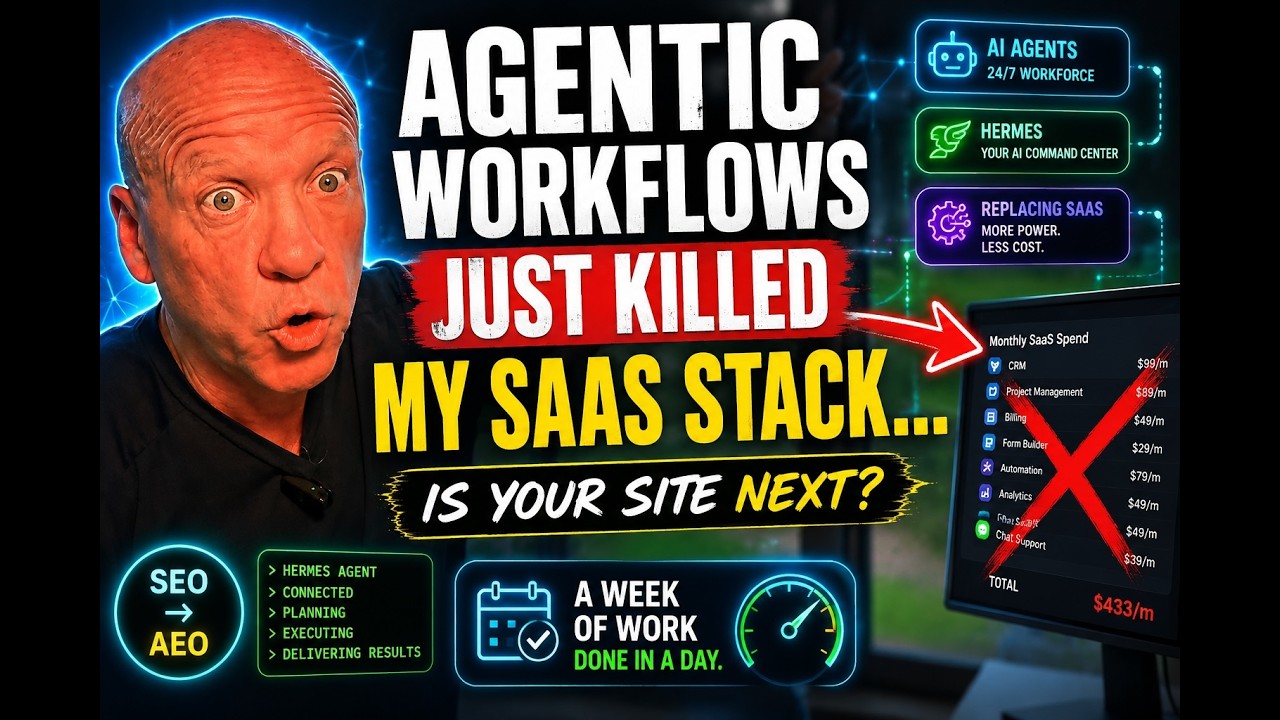
The Hermes agent also acts as a CEO advisor and, increasingly, as a Chief Financial Officer. It has access to Xero, handles invoice creation, and is now rebuilding SaaS products that weren’t designed to be agentic-friendly.
Replacing a $50/Month SaaS Tool — By Lunchtime
Here’s a recent example that says it all. There was a SaaS product with a $50 per month subscription fee. It wasn’t used all that often, and every time it was opened, the UX was terrible — completely unlike anything else — requiring a mental reset just to find your way around. It was slow, clunky, and frustrating.
So, the question was put to the agent: is there a similar product that has agentic access? After looking into it, the decision was made to simply build a custom version instead, using a third-party integration to handle the one specific function that couldn’t be built from scratch. The result? More than half the SaaS cost was cut, and there’s no longer any need to leave the agent environment to use the tool. You just say, “go do this thing,” and the agent connects directly, uses the tool with full business context, and gets it done.
A Week’s Work in a Day
The productivity shift has been staggering. What would previously take a week to complete is now being done in a single day. The work itself is no longer the bottleneck. As was explained to a client recently — especially on Shopify sites — the capability to act is there, but the pacing must be deliberate. You don’t want to make changes too quickly, because you need to allow time for the bots to crawl the site, absorb the data, assess it, and update their understanding of the pages accordingly. The constraint is now the crawl cycle, not the workload.
And that opens new market opportunities.
The Agentic-First Web Is Coming
Despite all the hype around AI search versus SEO, the bigger picture is about something more fundamental: the world is shifting to an agentic-first web. Agents are going to become the primary visitors to your website — whether that’s Google’s own agents, or a custom agent like Hermes going out to research a site on your behalf. Everything is moving agents-first.
The reason this prediction is made with confidence is simple: it makes life easier. It’s a better experience. As the saying goes, water finds its own level — and if using agents makes more sense for users, that’s the direction the world will go. It’s as straightforward as that. This was covered in depth in the book, and it continues to play out exactly as expected.
Real Results: Revenue Up, AI Crawl Activity Up
A couple of weeks ago an example was shared, and there’s now a progress update. Two Shopify sites where the recommended changes were applied — changes identified through our Shopify app SKAW — have both seen their revenue increase since those fixes went live. On top of that, both sites have recorded an increase in crawl activity from Google AI bots, as shown in SKAW’s AI Activity Report.
The rollout to more clients is now underway. Of course, with any client there are multiple things happening at once, so careful scheduling is important — you need to make sure one change isn’t affecting another or muddying the data you’re trying to measure.
SKAW for WooCommerce Is Coming
For everyone who has been asking, yes, SKAW for WooCommerce is in development. The finishing touches are being applied right now, and a couple of beta testers are lined up to put it through its paces very soon.
That’s it for this week — see you next week! If you have any questions, comments, or you’d like to book me for a speaking gig, feel free to reach out to me a jim@stewartmedia.biz.
